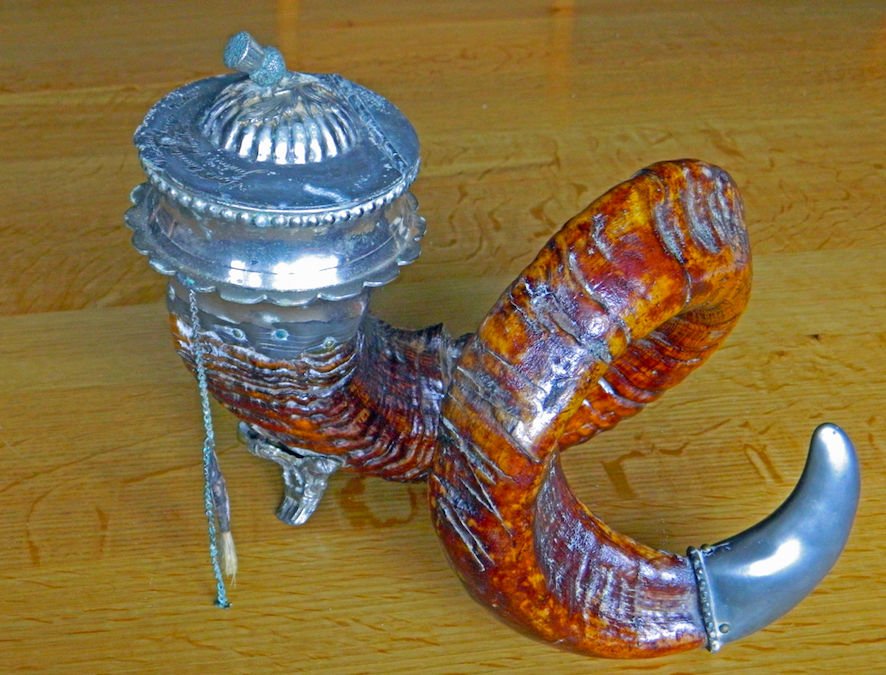
The society has owned a ram’s horn snuff holder since 1874 that was returned to us several years ago following the death of Life member James Inglis.
Known as a Scotch mull or sneeshing mull, the horns were often highly decorated. The term “mull” derives from the Scottish pronunciation of “mill,” a device used to ‘pulverize’ or grind tobacco fine enough to be inhaled through the nose. Sneeshing loosely means sneezing, the sometimes explosive result of inhaling the snuff.
Mulls were often made of a natural ram’s horn, sometimes artificially curved at the narrow end, with a decorated, engraved, hinged box or cup at the wide end. The lid was often silver, decorated with a gemstone or similar item. Mulls, especially the more expensive mulls, would include an attached spoon and brush or rabbit’s foot. The spoon was used to apply the snuff to the nose and the rabbit’s foot or brush for “wiping the upper lip.” Mulls were available in various sizes. A smaller mull was for more personal use while a larger, or communal, mull was intended for larger gatherings.
Our mull fits the classic description: a curved ram’s horn with a silver cap on the narrow end, silver legs to support it, a silver cup at the wide end with a hinged, engraved lid decorated with a thistle, and a spoon and brush attached by a fine metal chain (the spoon is missing). The cup still contains a bit of cinnamon colored, now-odorless, snuff residue. The lid is engraved “Presented to the Scots’ Charitable Society, Boston, James M. Smith, 1874.”
James Milne Smith was admitted to the society in 1865 and was President of the society in 1872. His son, James Milne, Jr., was admitted in 1881.
A good source of information on snuff and the various snuff boxes and mulls that were once very popular is Mattoon M. Curtis’ enjoyable 1935 book, Book of Snuff and Snuff Boxes. This is available as a hard cover book or a downloadable digital copy.
 Scots' Charitable Society